Flaky Scalp at the Chair: Dandruff, Seborrhoeic Dermatitis or Psoriasis? A Field Guide for Stylists
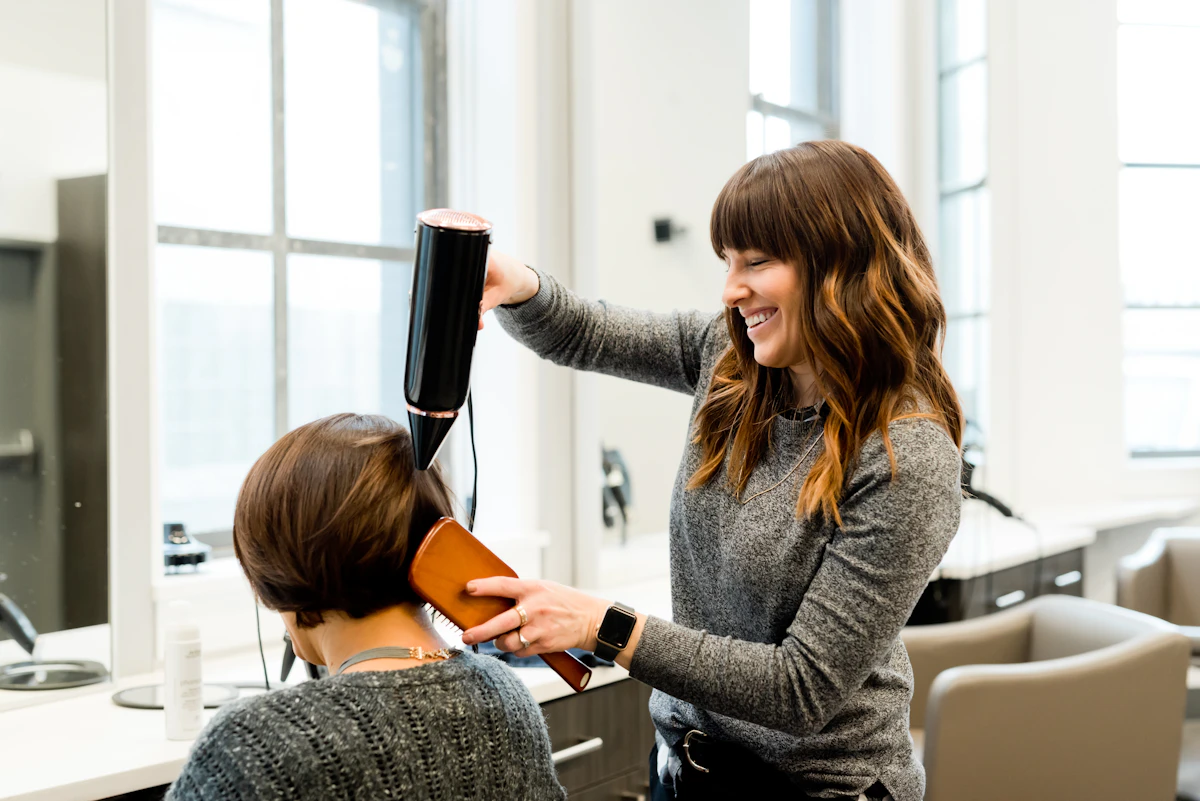
You part the hair for a root tint and the scalp is covered in flakes. Some are fine and white and fall onto the cape. Some are larger, slightly yellow and stuck to the skin. Along the back of the hairline there is a raised, scaly patch that runs onto the neck. The client says, a little embarrassed: "I know, it is terrible at the moment. Is it just dandruff? What shampoo should I buy? Can you still do my colour?"
Every stylist hears some version of that question, and it gets more common as the weather turns cold. The honest answer is that flaking is a sign, not a diagnosis. Dandruff, seborrhoeic dermatitis and scalp psoriasis are the three most common explanations, and they overlap, but a flaky scalp can also be caused by contact dermatitis, a fungal infection, head lice, or simply product build-up and a dry scalp.
This field guide is written for UK stylists and salon teams. It explains how the three common conditions tend to look and behave, how to tell them apart enough to give sensible advice, which other causes to keep in mind, how to adapt or pause a service, what to say, and when to refer. You will not be diagnosing anyone. The aim is to observe carefully, advise within your role, and refer well.
Short answer: fine white or grey flakes with mild itch and no obvious redness usually point towards ordinary dandruff, which often responds to an over-the-counter anti-dandruff shampoo used for up to 4 weeks. Greasy, yellowish scale with redness that also appears on the eyebrows, sides of the nose or ears points more towards seborrhoeic dermatitis. Thick, well-defined, raised patches with silvery scale, often at the hairline, behind the ears or on the neck, point more towards psoriasis. A scaly patch with broken hairs or hair loss, a scalp that is very red, swollen, sore or weeping, or flaking that has not improved after 4 weeks of anti-dandruff shampoo all mean refer, not guess.
Why flaky scalps matter for salons
Flaking is one of the most visible scalp concerns clients have, and one of the most emotional. Flakes on a dark jumper are noticed by other people, and many clients feel judged for it. The NHS is clear that dandruff is not caused by poor hygiene, is not harmful, and cannot be caught: https://www.nhs.uk/conditions/dandruff/. That alone is worth saying out loud at the chair, because a lot of clients quietly believe the opposite.
Flaking is also common. The British Association of Dermatologists (BAD) describes dandruff as seborrhoeic dermatitis of the scalp in its mildest form, and notes that it is very common, affecting almost half of all adults regardless of age, ethnicity or gender: https://www.bad.org.uk/pils/seborrhoeic-dermatitis. That means most salons see it daily, whether or not anyone mentions it.
For the business, flaking affects the service, because chemical work on an inflamed or broken scalp carries more risk, and the relationship, because handling it kindly builds trust. The Knowledge Hub's guide to growing salon revenue with scalp care covers the commercial side: https://trichologyacademy.co.uk/blog/salon-revenue-scalp-care.
Dandruff: the common, mild end of the spectrum
The NHS describes dandruff as white flakes of skin on the scalp and in the hair, often more noticeable in darker hair and when they fall onto the shoulders. The scalp may also feel dry and itchy. It says dandruff may be caused by different things, including a type of yeast that naturally lives on the skin and skin conditions such as eczema, and that stress and cold weather may make it worse: https://www.nhs.uk/conditions/dandruff/.
What you tend to see at the chair
- Small, loose, white or greyish flakes spread fairly evenly across the scalp, often most obvious along partings.
- Flakes that brush away easily and collect on the cape or the client's shoulders.
- Mild itch, with little or no visible inflammation.
- No thick patches, no clear edges, and no hair loss linked to the flaking.
- A pattern that comes and goes, often worse in autumn and winter, or during stressful periods.
What the NHS suggests clients try
The NHS advises using an anti-dandruff shampoo from a pharmacy or supermarket, looking for one that contains ketoconazole, coal tar or salicylic acid, and using it for up to 4 weeks to see if the dandruff improves. It notes that a person might need to try more than one type, and that a pharmacist can explain how to use the shampoo. The BAD leaflet also lists zinc pyrithione and selenium sulphide as common anti-dandruff ingredients, and advises massaging the shampoo into the scalp and leaving it for 5 to 10 minutes before rinsing.
That gives stylists a sensible, evidence-based starting point. You can explain that medicated shampoos are designed to work on the scalp rather than the lengths, that contact time matters, and that the pharmacist is the right person to advise on which product and how often. What you should avoid is promising that a particular shampoo will cure it. Dandruff tends to return, and the NHS ketoconazole guidance notes that some people use the shampoo every 1 to 2 weeks for months or years to keep it away: https://www.nhs.uk/medicines/ketoconazole/common-questions-about-ketoconazole/.
Seborrhoeic dermatitis: when flaking comes with redness and greasy scale
The BAD explains that seborrhoeic means the rash affects the greasy, or sebaceous, skin zones such as the face, scalp, centre of the chest and back, and that dermatitis means the skin is inflamed, red, itchy and flaky. On the scalp it ranges from mild flaky skin, which is dandruff, to inflamed skin with much more scale which can weep. It is also known as seborrhoeic eczema.
The Academy's condition page describes seborrhoeic dermatitis as a common, long-term, recurring inflammatory condition that appears on the scalp as red, yellowy, flaky scales, which can also affect the nasal folds, eyebrows, armpits and groin, and which can be managed but not cured. It lists genetic predisposition, yeast (Malassezia), stress and temperature change as causes and risk factors, and notes that it is often worse in winter: https://trichologyacademy.co.uk/education/conditions/seborrheic-dermatitis.
What causes it
The BAD says the cause is thought to involve many factors and is still being researched. A harmless yeast called Malassezia lives on normal skin, but is found in higher amounts in seborrhoeic dermatitis, and current thinking is that a combination of skin barrier changes and increased sensitivity to substances the yeast produces leads to inflammation. Flares can be triggered by tiredness, stress, and cold, dry weather. For clients, the most useful message is that it is not a hygiene problem and it is not catching.
What you tend to see at the chair
- Flakes that are larger, greasier and more yellowish than ordinary dandruff, sometimes stuck to the scalp.
- Redness or inflammation under the scale. On brown and black skin the BAD notes the skin can look lighter or darker than the surrounding skin rather than red.
- Involvement beyond the scalp: eyebrows, the creases beside the nose, in and behind the ears, and sometimes the eyelids or the centre of the chest.
- Itch or soreness that flares and settles, often worse in winter or when the client is run down.
- Scale that tends to be more diffuse, without the sharply defined, thick plaques typical of psoriasis.
The facial clue is often the most helpful one for stylists. If you notice flaking in the eyebrows or redness and scale around the sides of the nose as well as on the scalp, mention it gently. The NHS dandruff page advises seeing a GP if a person has flaky, itchy patches on their face or other parts of the body.
Scalp psoriasis: thick, defined, silvery plaques
The NHS describes psoriasis as a common skin condition that causes itchy and painful patches of dry, flaky skin, forming what look like silvery-white scales. Patches are usually pink or red on white skin, and may look grey on brown or black skin, sometimes leaving dark marks after they clear. It lists the head and behind the ears among the most common places for psoriasis, explains that it is thought to be caused by a problem with the immune system, that it is more likely if a family member has it, and that it is not contagious: https://www.nhs.uk/conditions/psoriasis/.
Psoriasis UK explains that the scalp is one of the most common places for plaque psoriasis to appear, and often the first area affected. It appears as raised, red, or darker on darker skin tones, patches covered with silvery, white or yellow scale, and loose scale can look very similar to dandruff. It may be visible around the hairline, on the forehead, neck and behind the ears: https://psoriasisuk.org.uk/scalp-psoriasis.
What you tend to see at the chair
- Raised patches with a clear edge that you can often feel with your fingertips as a rough or thickened area.
- Thick, silvery-white scale that is bound down to the skin, rather than loose flakes sitting on it.
- Patches that extend just past the hairline onto the forehead, behind the ears or onto the back of the neck.
- Itch, tightness or soreness, especially if the skin has cracked.
- Sometimes psoriasis elsewhere that the client mentions, such as elbows, knees or the lower back, or pitting and dents in the fingernails, which the NHS lists as a feature.
Psoriasis and hair
Clients with scalp psoriasis sometimes worry about losing hair. Guy's and St Thomas' NHS Foundation Trust notes that scalp psoriasis can sometimes cause hair loss, but that the hair will normally grow back when the inflammation and scaling clears: https://www.guysandstthomas.nhs.uk/health-information/treating-scalp-psoriasis. Psoriasis UK says thinning is often due to a build-up of scale or scratching. That is reassuring, but any hair loss with a scaly scalp still needs a medical opinion, because some other causes of scaling and hair loss do need specific treatment.
Comparison table: dandruff, seborrhoeic dermatitis or psoriasis?
Read each row as: feature / more typical of dandruff / more typical of seborrhoeic dermatitis / more typical of scalp psoriasis. This is a recognition aid only. The conditions overlap, a client can have more than one, and only a GP, dermatologist or qualified trichologist can assess them properly.
- Flakes / Small, loose, white or grey, brush away easily / Larger, greasier, yellowish, may stick to the scalp / Thick, silvery-white scale bound to raised patches
- Redness or colour change / Little or none / Often present under the scale; may look lighter or darker on brown and black skin / Usually present; pink or red on white skin, grey or darker on brown and black skin
- Edges / No clear edges, spread across the scalp / Diffuse, poorly defined / Well defined, raised plaques you can often feel
- Typical sites / Scalp, partings, shoulders / Scalp plus eyebrows, sides of the nose, ears, sometimes eyelids and chest / Scalp, hairline, forehead, behind the ears, neck; often elbows, knees, nails
- Sensation / Mild itch, scalp may feel dry / Itch, soreness or sensitivity / Itch, tightness, sometimes soreness or cracking
- Pattern over time / Comes and goes, often worse in cold weather or with stress / Long-term and recurring, often worse in winter / Flares and settles; triggers include stress, injury to the skin and some medicines
- First step / Anti-dandruff shampoo for up to 4 weeks, pharmacist advice / Pharmacist or GP, especially if the face is involved / GP, who may refer to a dermatologist
- Refer to GP if / No better after 4 weeks, very itchy, red or swollen / Spreading, sore, weeping, or not settling with treatment / Suspected and not yet assessed, treatment not working, or joint pain and swelling
Other causes of a flaky scalp to keep in mind
The NHS dandruff page includes a useful table of other conditions that can look like dandruff. Several of them are relevant to salons, and a couple of them change what you should do immediately.
Contact dermatitis from products
The NHS lists contact dermatitis (red, irritated skin which may blister and crack) as a reaction to products such as hair dye, sprays, gels or mousses. If the flaking started after a new product or a chemical service, or it is concentrated along the hairline where styling product sits, contact dermatitis is worth considering. The Academy's condition pages on irritant contact dermatitis and allergic contact dermatitis explain the difference: https://trichologyacademy.co.uk/education/conditions/irritant-contact-dermatitis and https://trichologyacademy.co.uk/education/conditions/allergic-contact-dermatitis. The Knowledge Hub's guide to scalp reactions after colour covers what to do at the chair: https://trichologyacademy.co.uk/blog/scalp-reaction-after-hair-colour-irritation-or-allergy.
Scalp ringworm (tinea capitis)
The NHS describes scalp ringworm as a fungal infection that can cause a scaly, dry, swollen or itchy rash which may look red or darker than the surrounding skin, and which on the scalp may cause patchy hair loss. It is passed on through close contact with an infected person or animal, or through shared objects such as combs and towels, and the NHS advises seeing a GP for ringworm on the scalp, because it usually needs prescription antifungal tablets and shampoo: https://www.nhs.uk/conditions/ringworm/.
For a salon this is the main reason not to assume every scaly scalp is dandruff. A scaly patch with broken hairs or hair loss, particularly in a child, should be referred to a GP before any service. Clean and disinfect combs, brushes and capes in line with your usual hygiene procedures, and use fresh towels.
Head lice and nits
Itching and white specks are sometimes head lice rather than flakes. The NHS describes nits as brown or white eggs attached to the hair: https://www.nhs.uk/conditions/head-lice-and-nits/. The practical difference at the chair is that flakes slide off the hair easily, whereas nits are firmly stuck to the hair shaft close to the scalp. If you suspect lice, handle it discreetly, follow your salon's policy, and point the client to the NHS guidance on detection combing.
Eczema, dry scalp and product build-up
The NHS also lists eczema (dry, red, flaky and very itchy skin) as a possible cause. Hot water, harsh products and indoor heating can leave some scalps dry and tight. Dry shampoo, styling products and conditioners applied to the roots can leave residue that looks like flaking. A thorough shampoo usually tells you quickly whether you are looking at residue or skin. It is worth asking about routines before assuming a skin condition, and worth not shaming the client either way.
A simple observe, ask, record routine
You do not need special equipment to give flaky scalps a structured look. Build the same short routine into every consultation where you notice scaling, so it becomes normal rather than awkward.
Observe
- Part the hair in several places: front hairline, crown, sides, nape and behind the ears.
- Note the flake type: fine and loose, greasy and yellowish, or thick and stuck down.
- Note any redness or colour change, and whether there are clear edges you can see or feel.
- Look beyond the scalp if it is natural to do so: eyebrows, sides of the nose, ears, the back of the neck.
- Check for broken skin, weeping, crusting, scratch marks, broken hairs or patches of hair loss.
Ask
- How long has it been like this, and does it come and go?
- Is it itchy, sore, tight or burning?
- Have you noticed it anywhere else, such as your face, ears, elbows or knees?
- Have you changed any products, had a new chemical service, or started any new medication?
- What have you tried so far, and for how long?
- Has a doctor or pharmacist ever looked at it?
Record
With the client's consent, note what you saw, where, and what they told you, and take photos if your salon has a consent process for that. A record helps you notice change over time and gives the client something concrete to show a pharmacist or GP.
Adapting the service: when to carry on, adapt or pause
A flaky scalp does not automatically mean no service. The decision depends on the condition of the skin on the day, not the label.
Usually fine to carry on, with care
- Mild, loose flaking with intact skin and no soreness.
- A client with a known, assessed condition whose scalp is currently calm, who is following their treatment plan, and who has a clear allergy alert test where one is required.
- Services that do not touch the scalp, such as many highlighting and balayage techniques. Psoriasis UK notes that things that do not touch the scalp, such as highlights, should be fine for clients with scalp psoriasis.
Adapt the service
- Use lukewarm rather than hot water and gentle fingertip pressure rather than nails.
- Avoid scrubbing, picking or lifting scale with a comb. Picking at plaques can injure the skin, and the NHS lists cuts, scratches and grazes as a psoriasis trigger.
- Keep heat styling cooler. Psoriasis UK suggests limiting hot styling and using cooler dryer settings.
- Choose an off-scalp colour technique where possible, and keep product away from active patches.
- Ask whether the client has a prescribed scalp treatment schedule, and work around it rather than against it.
Pause chemical services and refer
- Broken, cracked, weeping or crusted skin. Psoriasis UK advises that if there is broken skin on the scalp, it is not advisable to have dyes or perms applied.
- A scalp that is very red, swollen, hot or painful.
- A scaly patch with broken hairs or hair loss.
- Flaking that started after a colour or chemical service, which could be a reaction.
- Anything you are not sure about. Postponing a colour by a couple of weeks costs far less than a reaction or an infection.
When you pause, be clear that it is about protecting the client's skin, not a judgement. Offer an alternative such as a cut, a gentle treatment, or a rebooked colour once the scalp has settled or been assessed.
What to say at the chair
Language matters more with flaky scalps than almost any other concern, because embarrassment is so common. These are starting points to adapt to your own voice.
When a client apologises for their flakes
- "Please do not worry. Flaking is really common, and it is not about how clean you are. It is just how some scalps behave, especially in colder weather."
When it looks like ordinary dandruff
- "This looks like fine flaking without much irritation. Anti-dandruff shampoos from the pharmacy are a sensible first step. A pharmacist can help you choose one and explain how to use it."
- "Massage it into the scalp rather than the lengths and give it a few minutes before rinsing. If it is no better after about four weeks, it is worth seeing your GP."
When it looks more inflamed or extends beyond the scalp
- "I can see some redness and the flaking goes onto your hairline and behind your ears. I cannot tell you what it is, but it is worth getting it looked at by your GP, because there are treatments that can help."
- "Have you noticed anything similar on your eyebrows, your face, or your elbows or knees? That is useful information for your doctor."
When you need to postpone colour
- "The skin is a bit broken in a couple of places today, and I would rather not put colour on it. Let us do your cut today and rebook the colour once your scalp has settled."
- "I would like you to get this checked first. As soon as you have, we can plan the colour around whatever you have been advised."
Having these conversations confidently, without diagnosing, is the focus of Module 02 of Salon Trichology Essentials, Client Conversations That Build Trust, while Module 01, Recognising Common Scalp Concerns, covers what you are seeing on your clients' scalps, and Module 03, Know Your Boundaries, covers when to help, when to refer and how to protect yourself. The course runs 240 minutes on demand for £99: https://trichologyacademy.co.uk/education/salon-trichology-essentials.
Retail and home care: helpful without overpromising
Clients will ask what to buy. You can help, as long as you stay within honest limits.
- Point to the active ingredients the NHS and BAD mention, such as ketoconazole, coal tar, salicylic acid, zinc pyrithione and selenium sulphide, and let the pharmacist advise on choice and frequency.
- Explain how to use medicated shampoos: on the scalp, massaged in, left for a few minutes, then rinsed, with a regular conditioner on the lengths if the client wants one.
- Never suggest stopping or replacing a prescribed treatment. If a client is unhappy with a treatment, the answer is to go back to the prescriber.
- Avoid any claim that a salon product cures dandruff, seborrhoeic dermatitis or psoriasis. None of them can be cured, and the honest message is management and control.
If you want to understand product labels better, the free Product Ingredient Literacy quiz is a quick way to test your team: https://trichologyacademy.co.uk/quiz/product-ingredient-literacy. The Knowledge Hub's guide to scalp detox treatments also explains what salon scalp treatments can and cannot do: https://trichologyacademy.co.uk/blog/future-of-scalp-detox.
What not to do
- Do not tell a client they have dandruff, seborrhoeic dermatitis or psoriasis. Describe what you see and suggest who can assess it.
- Do not pick, scrape or comb off thick scale in the salon.
- Do not apply colour, bleach or perm solutions onto broken, weeping or crusted skin.
- Do not recommend or supply prescription-only treatments, or advise on steroid creams. That is for a pharmacist, GP or dermatologist.
- Do not ignore a scaly patch with hair loss. It needs a GP assessment before you carry on.
When to refer, and to whom
Pharmacist
For mild flaking and itch with no other worrying features, the NHS suggests starting with an anti-dandruff shampoo and asking a pharmacist how to use it.
GP
The NHS dandruff page advises seeing a GP if symptoms continue after using an anti-dandruff shampoo for at least 4 weeks, if the dandruff is bad or the scalp is very itchy, if the scalp is red or swollen, or if there are flaky, itchy patches on the face or other parts of the body. The NHS psoriasis page advises seeing a GP for symptoms of psoriasis, if treatment is not working or causing side effects, or if there is pain, stiffness and swelling in the joints that keeps coming back. A GP can refer to a dermatologist where needed.
Urgent help
The NHS psoriasis page lists rare situations that need emergency care, such as skin that quickly turns red with white, pus-filled bumps that join together, especially if the person also feels unwell or has a high temperature. These are unusual, but if a client describes rapidly spreading redness with pus-filled bumps and feeling unwell, advise them to call 999 or go to A&E.
Trichologist
A qualified trichologist can carry out a structured hair and scalp assessment, work alongside medical care, and help clients understand and manage long-term scalp conditions. Lorraine's clinic in Knutsford offers consultations for clients who want a specialist hair and scalp opinion: https://trichologyacademy.co.uk/clinic.
Share your notes and consented photos to make the handover easy. The Knowledge Hub's guide to patchy hair loss red flags lists the scalp signs that always mean pause and refer: https://trichologyacademy.co.uk/blog/patchy-hair-loss-red-flags-when-to-refer.
For salon owners: make flaky scalps a team skill
Because flaking is so common, it is one of the best places to start building scalp confidence across a team. A consistent approach protects clients, reduces awkward moments, and makes your salon the place clients trust with their scalp as well as their hair.
- Start with the free Scalp Dermatitis & Inflammation Basics quiz to see where your team's knowledge sits: https://trichologyacademy.co.uk/quiz/scalp-dermatitis-inflammation.
- Use the free Scalp Health Check as a gentle, client-facing starting point: https://trichologyacademy.co.uk/quiz/scalp-health-check.
- Train the team in reactive and inflamed scalps with the £29 module Sensitive Scalps: Redness, Itching & Inflammation Explained (30 minutes, watch anytime). It covers why scalp sensitivity and inflammation develop, common triggers, early signs of inflammation, calming and protecting the scalp barrier, and when referral to a medical professional is appropriate: https://trichologyacademy.co.uk/education/videos/sensitive-scalps.
- Give every stylist a shared framework for observing, talking and referring with Salon Trichology Essentials, £99: https://trichologyacademy.co.uk/education/salon-trichology-essentials.
- For senior stylists and practitioners who run longer consultations, Hair Loss Assessment & Client Communication (300 minutes, £250) covers structured assessment and emotional consultations: https://trichologyacademy.co.uk/education/hair-loss-assessment-communication.
- For hands-on learning in the salon, the in-person workshops include a Salon Team Training Day and an Advanced Scalp Analysis Workshop: https://trichologyacademy.co.uk/education/workshops.
All Academy training is listed at https://trichologyacademy.co.uk/education, and the condition library is at https://trichologyacademy.co.uk/education/conditions.
FAQ
Is dandruff caused by not washing hair enough?
No. The NHS says dandruff is not caused by poor hygiene, although it may be more obvious if hair is not washed regularly. It is also not contagious.
How can a stylist tell seborrhoeic dermatitis from psoriasis?
Often you cannot with confidence. The BAD notes that seborrhoeic dermatitis can sometimes be difficult to distinguish from other rashes, even for doctors. As a rough guide, seborrhoeic dermatitis tends to have greasier, yellowish, more diffuse scale and often affects the eyebrows and sides of the nose, while psoriasis tends to form thick, well-defined, raised plaques with silvery scale, often at the hairline and behind the ears. Either way, the action is the same: describe what you see and suggest a GP.
Can I colour a client with scalp psoriasis or seborrhoeic dermatitis?
Often yes, if the skin is intact and calm, the client has had any allergy alert test the manufacturer requires, and you keep product off active patches where possible. Psoriasis UK advises against dyes or perms on broken skin. If the scalp is cracked, weeping, crusted or very inflamed, postpone and rebook.
How long should a client try an anti-dandruff shampoo before seeing a GP?
The NHS suggests using it for up to 4 weeks, and seeing a GP if symptoms are still there after at least 4 weeks, or sooner if the scalp is very itchy, red or swollen, or there are flaky patches on the face or body.
Can flaky scalp conditions cause hair loss?
Severe scalp psoriasis can cause temporary thinning, usually from scale build-up or scratching, and the hair normally grows back once it is controlled. But scaling with patchy hair loss can also be a sign of scalp ringworm, which needs prescription treatment, so it should always be checked by a GP.
Key takeaways
- Flaking is a sign, not a diagnosis. Dandruff, seborrhoeic dermatitis and scalp psoriasis are the commonest causes, and they overlap.
- Fine, loose, white flakes with little redness lean towards dandruff; greasy, yellowish scale with facial involvement leans towards seborrhoeic dermatitis; thick, defined, silvery plaques at the hairline and behind the ears lean towards psoriasis.
- Contact dermatitis, scalp ringworm, head lice, eczema, dry scalp and product build-up can all look similar.
- A scaly patch with hair loss, a very red, swollen or weeping scalp, or flaking that has not improved after 4 weeks of anti-dandruff shampoo means refer.
- Do not colour or perm onto broken skin. Adapt or postpone, and rebook once the scalp is calm.
- Tell clients kindly that flaking is common, not about hygiene, and not catching.
Chair rule for flaky scalps: loose white flakes, try a pharmacy anti-dandruff shampoo for up to 4 weeks. Redness, greasy scale on the face, or thick plaques at the hairline, suggest a GP. Hair loss in a scaly patch, or broken and weeping skin, pause the chemical service and refer. Train your whole team on the same approach with Sensitive Scalps at https://trichologyacademy.co.uk/education/videos/sensitive-scalps and Salon Trichology Essentials at https://trichologyacademy.co.uk/education/salon-trichology-essentials.
Ready to improve your scalp health?
Whether you need professional guidance or want to learn evidence-based scalp care techniques, Lorraine can help you find the right path.
Not sure where to start?
Interested in training?
Explore video courses, structured training programs, or discuss bespoke workshops for your team.
Explore training optionsNeed a personal consultation?
In-person hair and scalp visits are in Knutsford. Booking is by enquiry or phone, with a reply within 24–48 hours.
Knutsford clinic